 Sideshift
 exchanges deposited crypto and sends the converted assets directly to your wallet
Sideshift is a crypto exchange that sends converted assets directly to your chosen wallet. It supports fixed and variable rates across multiple blockchains. Each swap connects a deposit to a receiving address, with processing dependent on the required blockchain confirmations. BTC, ETH, and SOL are among its supported assets.
In short: A fixed quote reserves conversion terms during its validity window, while blockchain confirmations determine when deposit processing can begin.
The deposit address and receiving wallet have different jobs
A shift connects the deposited asset with the asset and network selected for delivery. Its deposit address accepts the incoming funds, while the receiving address identifies the destination for the exchanged coins. The service takes custody during conversion, then sends the output directly to that wallet. You don’t have to withdraw the completed swap from an exchange trading balance. The incoming deposit and outgoing settlement remain distinct transfers, each with its own transaction details.
How do fixed and variable rates change a swap?
Fixed rates reserve conversion terms for a limited window, while variable rates change until the deposit is received. A fixed order requires an exact send or receive amount. On the website, its rate window lasts 15 minutes after pressing Shift. For API integrations, the window starts when the quote is created, before the fixed shift is created.
The deposit must match the fixed order’s amount and validity conditions. An incorrect amount can require review or refund handling.
Variable orders accept amounts within their displayed deposit range, and the rate locks when the deposit is received. The API gives these orders a seven-day validity window. That longer window describes how long the order remains open; it doesn’t reserve the rate displayed when the order was created.
Deposit limits also affect whether a transfer can process automatically. Minimum amounts change with coin prices, network fees, and processing costs. Maximum amounts vary by asset. A transfer outside the range can enter review, so a variable rate doesn’t mean unrestricted deposit size.
A fixed shift settles only its first valid deposit; additional deposits require a refund address and are refunded. Variable shifts can process up to five deposits individually under their own conditions and applicable rates. Deposits beyond the fifth require a refund address before they can be refunded. Integrations shouldn’t encourage repeated deposits to one order.
Which costs affect the amount your wallet receives?
The conversion rate and applicable network fees determine the quoted receiving amount. Fixed-rate displays include network fees in the rate; variable-rate displays show those fees separately on the order page. Some routes incur receiving fees for sweeping deposited funds, and sending fees for delivering the output. These estimates can change with network conditions. Your sending wallet’s transaction fee also affects what you spend overall. Compare the amount arriving at the destination alongside the amount leaving your wallet.
Reading the ETH-to-BTC pairing before funding it
Does an ETH-to-BTC shift send both transfers on the same network? The pairing connects an ETH deposit on Ethereum to a BTC settlement on Bitcoin. The deposit address serves the incoming side, and the receiving address serves the outgoing side. An ETH deposit alone doesn’t establish that BTC has reached its destination.
Choose the rate and both networks before funding the order.
- Select Ethereum for the ETH deposit and Bitcoin for the BTC receiving address in this pairing.
- Match the fixed order’s exact amount, or keep a variable-rate deposit inside its displayed range.
- Read the receiving amount together with the network fees shown for the selected rate option.
- Use an unexpired order’s deposit address; an expired shift’s address can later be reassigned.
- Supply a compatible refund destination when the order or integration requests one.
The receiving address is for exchanged BTC. A refund destination must accept the deposited asset on its deposit network: ETH on Ethereum in this pairing. Supplying a refund address enables the refund process; any applicable review or holding period still affects its timing.
Wallet integrations, accounts, and Telegram extend access
Wallet integrations bring the exchange function into other applications. Trezor and Edge are documented integration partners, while the website provides the direct trading interface. An embedded interface changes where a shift starts, without changing which service converts the deposited assets. Supported pairs and network availability still govern the exchange.
Creating a website shift automatically assigns an account ID and records transaction history. Restoring that account on another browser requires its account private key.
The application programming interface, or API, lets integrations request quotes, create shifts, and monitor order status. A quote establishes proposed terms; creating a shift provides the order and deposit details. Integrations also need to preserve the user’s actual IP address when making requests through their servers, because access restrictions apply to the end user.
The Telegram bot provides another order interface, with fixed and variable rate choices, saved receiving addresses, and shift tracking. Its orders use the same exchange processing as website orders.
Integrations can earn commissions through the account attached to their requests. The API permits a commission from 0% to 2%, with 0.5% as the default, included within the exchange rate. The earnings dashboard tracks commission history and supports automatic payout settings. Separate referral links attribute eligible shifts to the account that shared them.
XAI and the ended staking program
XAI is the exchange’s native token, developed from the earlier SAI token. It uses the ERC-20 standard on Ethereum, with a maximum minted supply of 210,000,000 XAI. That issuance ceiling differs from circulating supply. The token can be exchanged through the service or traded through Uniswap; owning it is a separate activity from converting other supported assets.
The announced final XAI staking reward distribution date was June 3, 2026. The former program distributed rewards to stakers, and svXAI represented shares in the staking vault. Existing vault holdings remain redeemable for XAI. Withdrawal through the staking contract requires ETH for the Ethereum transaction fee. The web unstaking interface also requires a service account.
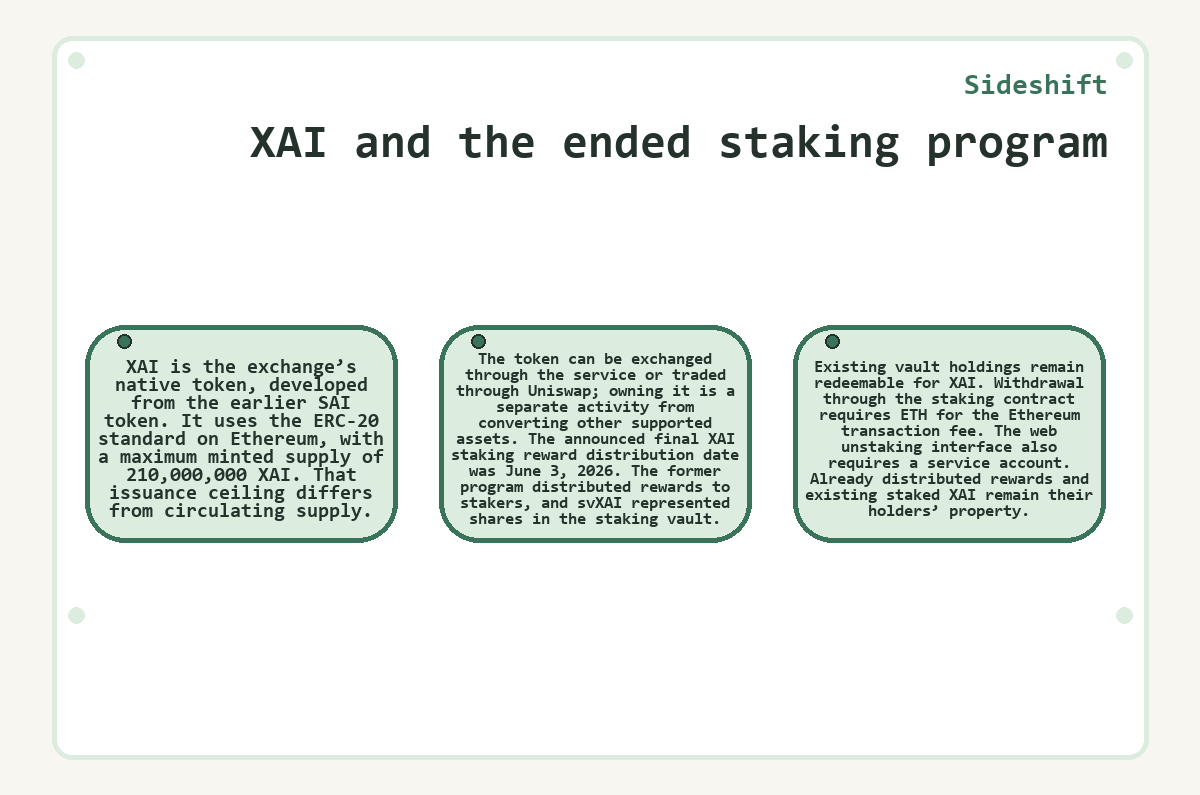
Already distributed rewards and existing staked XAI remain their holders’ property.
When does a shift become a completed transfer?
A shift completes when its deposit has been processed and outgoing settlement meets the applicable confirmation requirement. Most deposits require one block confirmation before processing. Litecoin, Dash, and Dogecoin deposits require two block confirmations before processing. A deposit that’s detected but unconfirmed is still pending. Network congestion and the fee paid for the incoming transaction influence that wait.
Risk screening can pause processing for human review. If reviewers accept a flagged shift, processing resumes. If they reject it, the service suspends the account and refunds the deposit after a holding period. Verification may shorten the wait, and serious flagged cases require it before a refund. Jurisdiction restrictions and beneficial-ownership requirements also apply, including ownership of the digital currency, the sending address, and the destination address.
Delivery has its own transaction state. In the API’s deposit-status model, settling means the outgoing transaction has been created and awaits confirmation. An order ID identifies the shift; outgoing transaction details identify the transfer sent to the receiving address. The API marks that individual deposit settled after its settlement transaction receives one block confirmation.
Sideshift: questions and answers
Is Sideshift available to residents of the United States?
Residents of the United States aren’t eligible to use the exchange. Its service terms also exclude United States citizens and nationals, while XAI has additional location and establishment restrictions. An embedded wallet interface or API integration doesn’t change those eligibility rules. Access depends on the person using the underlying service.
Does direct-to-wallet delivery make a swap anonymous?
Direct-to-wallet delivery doesn’t make a swap anonymous. Public blockchains can expose wallet addresses and transaction details. The exchange also collects transactional and device data, including IP addresses, and may request verification during compliance reviews. It retains data for operational and legal purposes and can share information with authorities where required.
Can I submit a spoken swap request to the Telegram bot?
The Telegram bot accepts short voice messages in AI mode after you opt in to transcription. It parses the request into an order proposal that needs review and confirmation before order creation. Text commands and the guided shift flow remain available, so voice input isn’t required to use the bot.
Which information helps support investigate a delayed shift?
The shift ID lets support locate the order. Provide it through support chat or a private support message with the issue you’re reporting. Don’t post it publicly: anyone with the ID can open the order page and, when no refund address was preset, may choose a refund destination or cancel the order.
How do deposit and settlement memos differ?
A deposit memo identifies the incoming transfer when the selected asset requires one, while a settlement memo accompanies the outgoing transfer when the destination requires it. The API keeps these values in separate fields. Use the memo associated with the relevant address; the incoming and outgoing values serve different destinations.
Are Sideshift referral commissions paid in XAI?
The referral program credits commissions in USDT on Ethereum. Its stated commission is 0.5% of eligible referred shift volume. A referral qualifies only if the person’s first visit to the service comes through that referral link. Previous visits prevent commission from applying, even when a later visit uses the link.
Can an integration reuse one API account for multiple users?
An integration uses its own API account across its users’ shift requests. That account represents the integration, and individual orders are distinguished by their shift IDs. Reusing the credentials doesn’t authorize sharing the account private key with users. The secret grants account access and must remain confidential.
Last updated -